


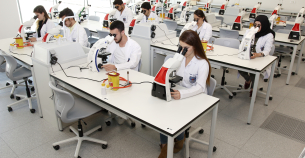

Our university has adopted a "quality-oriented" management system with an understanding that prioritizes efficiency and sustainable excellence in the services it offers in the fields of education, research, administrative processes, community service, and entrepreneurship.
Fundamental Principles of Our Quality Assurance Policy
- Adoption of the quality assurance system by leaders and staff
- Maximum stakeholder satisfaction
- Strategic management model
- Continuation of regular review and improvement efforts
In order to contribute to humanity, our university has adopted an education policy that aims to train professionals who:
Think critically, question, generate ideas, research, use technology effectively, keep up with the information age, act with team spirit, adhere to ethical values, respect people and the environment, are creative, know foreign languages, have high self-confidence, and lead in their fields,
and which is:
- A model at the national level
- Recognized internationally
- Focused on continuous learning and development
To implement up-to-date, student-centered and blended education methods that are shareable, sustainable, traceable, and measurable, even under challenging conditions, in line with the university’s mission, vision, education policy, and the requirements of the era, by utilizing the digital opportunities offered by technology.
- To develop an appropriate institutional culture and supportive environment for research that will contribute to universal science in the fields of health, life, and social sciences, and biotechnology
- To set strategies aimed at becoming a globally recognized university through research that contributes to universal science, supports entrepreneurship and innovation, by following international developments and innovations in science and technology
- To update strategies aimed at sustainability and development through continuous monitoring of the university’s research processes and outputs
- To support entrepreneurship with internal and external stakeholders for transforming discoveries resulting from research in health, life and social sciences, and biotechnology into products
Click to access the Strategic Goals of Research and Development
Click to access the Research and Development Priority Areas
- To train socially responsible professionals who are sensitive to individual and cultural differences, aware of societal conditions and problems, and focused on service and solutions, through community-oriented and in-community education
- To support social responsibility projects carried out within the community through curriculum-based courses and projects, as well as the voluntary activities of student clubs
- To encourage collaborations between external stakeholders, faculty members, and students within the scope of community service
- To ensure that all units’ research, development, and educational activities contribute to society; and to offer the products of advanced technology and human resources, especially in priority areas such as health, to the service of humanity
- To contribute to the scientific future of Turkey, society, and humanity by supporting innovative and entrepreneurial ideas at the Incubation Center
Click to access the Strategic Goals of Social Contribution
(1) The following principles shall be observed in the implementation of the University's human resources personnel policy:
a) Giving priority to the principles related to the University’s working procedures and the expertise required by the position in the selection of personnel to be employed,
b) Respecting the employee’s personality, protecting and safeguarding their rights,
c) Ensuring that employees work in positions suitable to their knowledge and abilities,
d) Establishing working conditions that enhance service quality in line with the University’s objectives,
e) Developing systems that encourage and reward success,
f) Taking measures to promote cooperation, solidarity, and motivation among University employees,
g) Regulating, developing, and supervising the employee’s sense of responsibility, work discipline, attitude, and behavior required by the position.
These principles are adopted as the “Human Resources Policy.”
- To increase international recognition and enhance international collaborations in education, teaching, and research
- To strengthen the university’s international impact
- To encourage international exchange programs and visits for students, academic staff, researchers, and administrative personnel
- To become a center of attraction for international students, highly qualified researchers, and faculty members
- To guide students for international careers
- To ensure international acceptance of educational programs
- To create a multicultural and international campus environment and to develop intercultural awareness and competencies among internal stakeholders
Click to access the Strategic Goals of Internationalization
This policy covers our university’s academic and administrative activities, the information assets related to these activities, and the relevant business processes carried out to protect these assets within the scope of information security.
Our Information Security Policy entails:
- Managing the Information Security Management System in accordance with ISO 27001:2022
- Ensuring the confidentiality, integrity, and availability of information by protecting our information assets
- Maintaining and improving the level of information security
- Evaluating and managing risks that may occur on information assets through risk management practices
- Complying with legal regulations regarding information security, taking necessary measures promptly in the event of security breaches, and applying appropriate sanctions when necessary
- Conducting awareness-raising activities and providing training for all our stakeholders regarding information security
- Committing to provide the necessary resources and training for the implementation and continuity of this policy
Principles have been defined at our university to ensure that the academic, professional, and social environment is completely free from gender-based discrimination and violence. Within this scope, a framework has been established to support awareness, prevention, support, and empowerment efforts, and infrastructure has been developed to contribute to the processes that will be implemented in the face of gender-based discrimination and violence.
Acıbadem Mehmet Ali Aydınlar University is committed to fostering an academic, professional and social environment grounded in diversity, equity, and inclusion (DEI). The University recognizes diversity as a core institutional strength and actively works to eliminate discrimination, structural barriers and inequalities across all areas of university life.
This policy document shows the university's determination to carry out its education, research, and societal contribution activities by considering this commitment. In line with this policy, any employee, student or visitor should be treated as such regardless of race, color, gender identity, sexual orientation or ethnicity. The policy endorses the prevention of harassment or discrimination against any person based on gender identity, national origin, religion, age or disability.
The University's DEI Policy and its implementation must be consistent with the Gender-Based Discrimination, Violence and Sexual Harassment Prevention and Support Policy. This latter policy is essential for defining the principles that guide the complete elimination of gender-based discrimination and violence in all aspects—academic, professional, and social—of Acıbadem Mehmet Ali Aydınlar University.
Institutional Commitment
The University adopts a zero-tolerance approach to discrimination, harassment, bullying and victimization. Equality and inclusion principles are embedded in governance, education, research, employment, student life and external engagement, in line with national legislation and international frameworks, including the UN Sustainable Development Goals (SDGs).
The University is committed to treat all employees, students, and visitors with respect regardless of race, color, gender identity, sexual orientation, or ethnicity. Furthermore, the University prohibits harassment or discrimination against any person based on gender identity, national origin, religion, age, or disability.
Scope and Coverage
This policy applies to:
Academic and administrative staff
Students and applicants
Visiting scholars, contractors, partners and visitors
It covers all university-related contexts, including recruitment, promotion, education, research, campus life, digital environments and institutional representation.
Equity and Equal Opportunity
Acıbadem University ensures fair, transparent and merit-based processes in recruitment, promotion, career progression and student admissions. Proactive measures are implemented to support underrepresented and disadvantaged groups and to promote gender balance at all levels.
Gender Equality and Intersectionality
Gender equality is a strategic priority. The University implements a Gender Equality Plan (GEP) aligned with European and international standards, addressing leadership balance, career development, work-life balance, inclusive governance and gender-sensitive research and education. An intersectional approach recognizes that individuals may experience multiple and overlapping forms of disadvantage.
Accessibility and Inclusion
The University is committed to providing accessible physical, digital and learning environments and to making reasonable adjustments for disabled staff and students. Inclusive teaching practices and curriculum design are promoted to reflect diverse perspectives and learning needs.
Governance and Accountability
Overall responsibility for DEI lies with the Rectorate, supported by the Diversity, Equity & Inclusion Council, which includes academic, administrative and student representatives. The Council oversees implementation, monitors progress and advises on institutional priorities. University’s Gender Equality Commission (TOCEK) works in close collaboration with the DEI Council.
Monitoring and Transparency
The University systematically collects and analyses anonymized equality data relating to staff and students. Progress is reviewed regularly and reported to governing bodies to ensure accountability and continuous improvement.
Safe Reporting and Complaints
Clear, confidential and fair procedures are in place for staff and students to report discrimination, harassment or misconduct. Retaliation against individuals who raise concerns in good faith is not acceptable.
Continuous Improvement
This policy is reviewed periodically to reflect evolving legal requirements, institutional priorities and best international practice, ensuring that diversity, equity and inclusion remain integral to Acıbadem University’s mission and values.
Purpose
The purpose of this Policy is to establish a healthy, safe, and sustainable environment for students, employees, and visitors on the University campus; to reduce health risks associated with the use of tobacco products; to support environmental sustainability; and to strengthen the University’s alignment with national and international health policies, in line with the acception of health promotion as an institutional priority at Acibadem University.
In line with its commitment to social responsibility, the University recognizes the promotion of a healthy lifestyle culture and the development of a campus model compatible with sustainable development goals as an institutional obligation.
Rationale
The World Health Organization (WHO) identifies tobacco use as one of the leading preventable causes of death and highlights its adverse impacts on health, social well-being, and environmental sustainability. In Türkiye, tobacco use—particularly among young populations—remains at levels that require significant public health attention.
The WHO Framework Convention on Tobacco Control (FCTC) provides a framework that promotes smoke-free public environments and the strengthening of education and awareness activities, while supporting international human rights standards such as the right to health and the right to a safe living environment.
Within the scope of the United Nations 2030 Agenda, the Sustainable Development Goals (SDGs) encourage the strengthening of tobacco control measures. SDG 4 recognizes healthy learning environments as a prerequisite for quality education, while SDG 12 and SDG 13 support efforts to reduce the environmental impacts of tobacco production and waste.
As a health-oriented university, and in line with our institutional approach that recognizes health as a fundamental human right, establishing a safe, healthy, and sustainable campus environment is one of our primary responsibilities. This Policy will serve protecting the right to health and to establish an institutional framework aligned with international obligations.
Scope
This Policy applies to all University campuses, including all indoor and outdoor areas, buildings, dormitories, social facilities, sports facilities, parking areas, and all vehicles owned or operated by the University. It also applies to all tobacco products, Electronic Nicotine Delivery Systems (ENDS) which include, but are not limited to, electronic cigarettes (e-cigarettes), vape devices, vaporizers, vape pens, e-cigars, e-pipes, and all similar electronic devices designed for nicotine delivery, and Electronic Non-Nicotine Delivery Systems (ENNDS), which include electronic devices that do not contain nicotine but are similar to ENDS in terms of their method of use, appearance, and aerosol exposure, and that are used through inhalation.
Policy Principles
- The use of tobacco products, ENDS, and ENNDS is not acceptable within University campus boundaries, except in areas designated by the University administration.
- This Policy applies to all students, academic and administrative staff, subcontracted employees, and visitors.
- During the transition period towards achieving a tobacco-free campus, designated smoking areas shall be established on campus.
- All University events (including congresses, seminars, ceremonies, and similar activities) shall be organized as tobacco-free events.
Supportive Measures
- Smoking cessation counseling and referral services shall be provided.
- Informative and awareness-raising educational activities shall be conducted.
- Visible warning and information signs shall be installed throughout the campus.
Implementation and Monitoring
The implementation of this Policy shall be carried out under the coordination of the Rectorate by the relevant units and/or committees. The effectiveness of the Policy shall be evaluated at regular intervals, and necessary improvements shall be made.
The procedures and principles regarding the implementation of this Policy shall be regulated through the Tobacco-Free Campus Implementation Directive to be issued by the University.